Overview
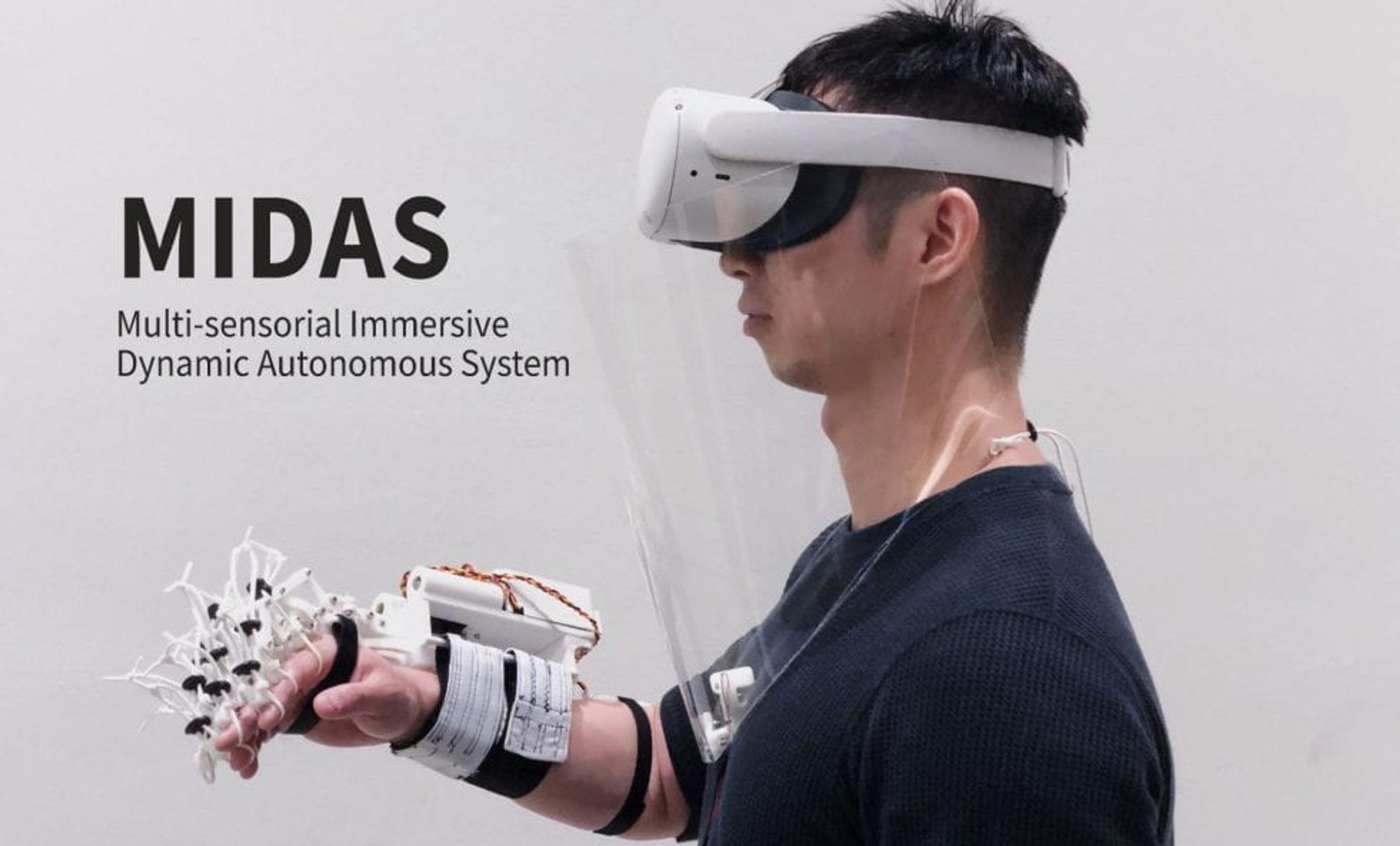
MIDAS (Multi-sensorial Immersive Dynamic Autonomous System) is a proof-of-concept rehabilitation system designed to improve motivation for hand rehabilitation in stroke-affected patients. It engages four of five primary senses—tactility, visual, auditory, and olfactory—through an integrated set of physical and immersive subsystems.
Developed through an interdisciplinary approach spanning rehabilitation, design/aesthetics, and wearable thinking, the project frames immersion and self-affirmation as part of the rehabilitation experience—not only mechanical assistance.
System components
The system consists of three main subsystems: (1) a hand exoskeleton, (2) a VR subsystem (headset + controller + game), and (3) an olfactory subsystem for scent delivery.
Intention is captured using EMG signals from the forearm to trigger physical assistance for opening/closing the fingers, connecting patient effort to both tactile support and in-game action.
Design principles
MIDAS is designed to be lightweight, portable, customizable, and affordable, with an emphasis on reproducibility via 3D printable parts and open-source-oriented development.
Beyond VR-as-motivation, MIDAS adds smell to deepen immersion, and introduces a wearable sleeve concept aimed at supporting proprioception via vibratory stimulation (weaved piezoelectrics).
Pilot study
A pilot study was conducted across three sessions with five stroke-affected participants, progressively adding subsystems per session. Reported results include high motivation scores (SRMS), strong excitement ratings, and no undesired side effects.
Credits & publication
Authors (paper): Fok-Chi-Seng Fok Kow, Anoop Kumar Sinha, Zhang Jin Ming, Bao Songyu, Jake Tan Jun Kang, Hong Yan Jack Jeffrey, Galina Mihaleva, Nadia Magnenat Thalmann, Yiyu Cai.